Showing posts with label 6th Grade Standards. Show all posts

Saturday, September 5, 2015

Exponents...Rule?

Personal Reflection:

Oh my goodness, I love it.  I'm pretty sure I found this on http://math-fail.com/ (which is a pretty fun site if you have time to search for the good stuff).

I love that this shows someone, who looks like a teacher, making the same conceptual errors our students do!  What a perfect way to get kids engaged in discussing not just the "rules" but the "whys" and "hows" of exponential notation.

Grade Level: 6-9

Course: 6th Grade, Pre-Algebra, Algebra

Standards:  6.EE.1, 6.EE.2, 8.EE.1, N-RN.1, N-RN.2, A-SSE.3, 
Skills: Algebra, Exponents, Exponent Rules, Powers, Bases


How to use this as a mad minute:
You have 60 seconds.  Explain why this teacher's simplification is incorrect.

How to use this as a warm up:
You could ask the students to consider one of the following:
1. What is the meaning of an exponent?
2. What is the difference between 3-squared and 3x2?
3.  Where in real life do we use exponents?  Why?
4.  What is the difference between the original expression and what the teacher wrote?  (Note:  Only for students who more experience with exponents!)

How to use this as a mini-lesson:
Some might wonder why I listed this as a 6th through HS level standard or lesson.  Truly it is because of the depth of thinking and analysis you could ask each level to bring to the table.  Ideally, the skill of simplifying this expression is an eighth grade standard.  However, exponents and the use of them is introduced in sixth grade and is, of course, expanded through high school.

If I were teaching middle school, I'd begin by revisiting the meaning of an exponent and might even ask students to write examples and expanded forms.  I'd continue by asking them to replace g-squared with another substitute or variable.  If they realize that the replacement should expand to x*x*x*x*x*x*x and if they also can say that g-squared should expand to g*g, they can quickly arrive at the idea that this is really g*g*g*g*g*g*g*g*g*g*g*g*g*g.  What a great review!

I'd return by asking kids to create their own "mistake" problem and prove the right answer.


How to use this as a full lesson?
I wouldn't use this as a full lesson unless you were knee-deep in your exploration of exponents and their properties.  If that is the case, you are probably teaching an eighth grade math class!  And if that is the case, you probably have a district-mandated curriculum.

This is a great supplement to that!  If you have used your primary curriculum to build understanding of exponents and their properties, you could use this as an exit slip for your lesson and simply ask students to explain the mistake in the teacher's thinking.

If you'd like, use this to launch the lesson.  Your students should already understand the meaning of exponents, but have probably not experienced "nested" exponents.  You can simply ask students to make sense of the original problem, make sense of what was written, and compare their answers.  Kids would have to dig deeply, with scaffolded questions, to get there, but I'm confident they could, as long as they have a solid understanding of exponents and their meaning.  (See the mini lesson above for some scaffolded questions.)


 How to use this as an assessment?
If your students are ready for an assessment, I would definitely put this photo on an exit slip, quiz, or test with a simple, "Explain the error in thinking shown here."

*Remember to think about what a proficient answer would entail, and what might a student to go beyond your expectations!

Please feel free to use any of these ideas and modify them to meet your needs.  However, please acknowledge the original source of the items and my own lesson outlines.  ©NatalieRSprigg 2015

Friday, April 25, 2014

Frozen Equations


Personal Reflection:

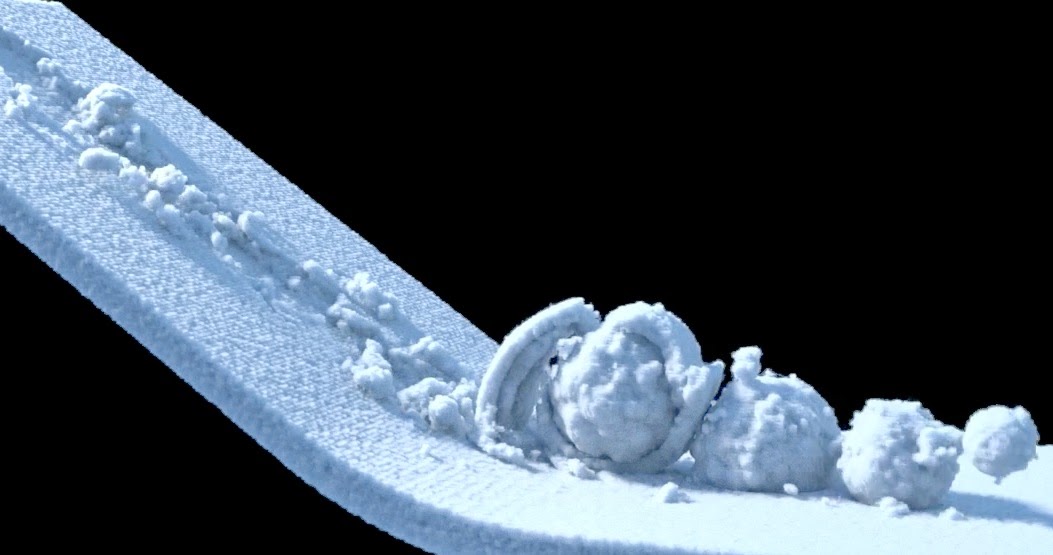
If you are an educator, you've probably been using Pinterest for a few years.  In fact, you probably found this post through Pinterest!  I'm fairly certain I found this image on Pinterest, but possibly on one of my other regular "fun" sites such as 9gag.com.  In an attempt to track down the original, I found this site.  It is not where I got the image, but it is a nice connection to the world of CGI and more detail about the snow effects in Frozen!

The site, linked above, has this amazing introduction, 
"Snow is a challenging natural phenomenon to visually simulate. While the graphics community has previously considered accumulation and rendering of snow, animation of snow dynamics has not been fully addressed. Additionally, existing techniques for solids and fluids have difficulty producing convincing snow results. Specifically, wet or dense snow that has both solid- and fluid-like properties is difficult to handle. Consequently, this paper presents a novel snow simulation method utilizing a usercontrollable elasto-plastic constitutive model integrated with a hybrid Eulerian/Lagrangian Material Point Method. The method is continuum based and its hybrid nature allows us to use a regular Cartesian grid to automate treatment of self-collision and fracture. It also naturally allows us to derive a grid-based semi-implicit integration scheme that has conditioning independent of the number of Lagrangian particles. We demonstrate the power of our method with a variety of snow phenomena including complex character interactions."
Wow.  That's technical.  In my own words?  "Snow is hard to animate.  While past methods worked fairly well, wet and dense snow was challenging because it acts like both a solid and a fluid.  In order to address this, engineers created a model that uses two different geometrical methods to animate snow.  They are able to use a Cartesian coordinate grid, along with programming, to simulate how snow both gathers (forms snowballs) and breaks (falls, hits, etc).  This sounds SO advanced, but I believe the analysis is totally approachable by a typical middle school student.  This is why I snagged the gif above and saved it, knowing that it would give some concrete meaning to students who are interested in the use of variables AND scientific notation!

Grade Level: 6-8

Course: Math, Pre-Algebra, Algebra

Standards:   6.EE.6, 6.EE.9, 7.EE.4, 8.EE.4

SMP: MP1, MP2, MP3, MP4, MP6, MP7, MP8
Skills: Variables, Algebraic Reasoning, Scientific Notation


How to use this as a mad minute:
You'll definitely need to preview this and explain the basics to the students.  However, after a short intro, a 1 minute number sense and reasoning check in might look like:

Compare the top two expressions carefully.  When you identify the difference in the expressions, and the subsequent snow fall, describe how you think the change in the scientific notation changes the snowfall.

How to use this as a warm up:
Again, after an intro, so students understand what this gift shows and where it comes from, I would challenge them to work with a partner to try to define what each "variable" controls, and how the change controls it.  (Hint:  It might be useful to name the snow fall quadrants A, B, C, and D in order to know which is which.  I will use A in the upper left and rotate clockwise through.)

A sample answer might be, "The equations on the right have ThetaS of 7.5 x 10^-3 and the snow is noticeably more clumpy or less-liquid than those on the left." (There are several comparisons they could make, so don't stop! Also, I would recommend you DON'T provide this example to the students prior to them working and struggling, it will be more productive that way!

How to use this as a mini-lesson?
I would start the same way as above, but prepare extension questions for students.  The exploration I outlined above, might only take 5 minutes, but a 20 minute mini-lesson could easily flow.
First, I would encourage students to share out, and convince others of their observations.  This is a great way to work on descriptive language, choosing appropriate adjectives, and talking about scientific notation.

To push students further, I would ask them to try to create their own equation that merges some of the changes.  Then challenge them to describe the resulting snowfall, and possibly even illustrate the final image.

How to use this as a full lesson?
Continuing on the trend above, I would then push students to explore more independently.

If your classroom has technology, I would visit the site:  http://www.cgmeetup.net/home/making-of-disneys-frozen-snow-simulation/ and have the students watch the video.  Another option would be for them to find a clip of the movie online and try to match which of the four quadrants a particular scene might be using.

This is another video of how artists used mathematics in creating the imagery in the movie Brave.

Depending on your focus, you may push students to analyze the scientific notation.  How big are these numbers?  What does that tell you about the size of the changes?

A great reading extension is this article from The New York Times about the Columbia University mathematicians who are working with film studios to enhance their computer graphics.

How to use this as an assessment?
I would not use this as an assessment, as it's probably a student's first exposure to this type of analysis.  However, if you've provided similar learning experiences for students, the Warm Up lesson is probably an opportunity for authentic assessment and analysis.


Please feel free to use any of these ideas and modify them to meet your needs.  However, please acknowledge the original source of the items and my own lesson outlines.  ©NatalieRSprigg 2014


Monday, July 1, 2013

FitBit Math

Personal Reflection:
I have a FitBit.  This is a Fitbit Zip, the smallest and most basic of the systems.  It clips on to your waistband, pocket, bra or shirt and tracks your steps.  I assume, based on the info you provide when you set up your online account, it then translates that movement into a distance traveled and a number of calories burned.  (This post will give your students a chance to explore whether or not this is true!)

Anyway, we've all heard that a goal of 10,000 steps a day is a great way to increase movement and to stay healthy.  How far is that?  How many calories does that burn?  Is that consistent?

As you know, I do a lot of thinking about "how much I have left" when I'm working out.  This is similar to my treadmill post, but slightly different.


Grade Level: 6-7

Course: Pre-Algebra, 6th and 7th grade math

Standards:  6.RP.1, 6.RP.2, 6.RP.3, 7.RP.1, 7.RP.2, 7.RP.3
SMP:  SMP1, SMP2, SMP3, SMP4

Skills: Ratios, Proportions, Unit Rates, Problem solving, Real world problems

How to use this as a mad minute:
You have 60 seconds. Estimate the number of steps someone takes in one mile.

How to use this as a warm up:
You could ask the students to consider one of the following:
1.  What is the relationship between steps and distance?
2.  What is the relationship between steps and calories?
3.  What is the relationship between calories and distance?
4.  Estimate the number of steps you would take in 10 miles.
5.  Estimate how far you would have to walk (either in steps or in distance) to burn off a large McDonald's French Fries.  (500 calories.)

How to use this as a mini-lesson:

0:00--I'd like you to take 60 seconds to brainstorm everything you know about ratios or proportions.
1:00--Partner up and share your ideas with a partner.  Make sure to add anything you forgot to your list!
2:00--Can we make a list of properties of ratios and proportions and define them?
4:00--I'm going to show you three photos.  (Link here.) When you look at them, don't talk to your friends, but take a minute to write down your immediate "math wonders" about the photos.
5:00--Take a second to reflect.  Are your questions mathematical?  Are you focused on applications of math and not off-topic?  If so, please share them with your partner.  When both have shared, select two questions you feel are your "best" and write them on the board.
7:00--Here you will want to zoom in on the most relevant and appropriate questions.  I suspect that several will be able to be answered through solving proportions.  Feel free to "prime" groups as you observe to encourage them to think proportionally.  I will post "pretend" questions for the remainder of the lesson based on what I would expect kids to "wonder" about.  It looks like we have a lot of questions about the distance and the steps!  Do you know what a "unit rate" is?  Think about this, if you can buy 4 candy bars for $1, how much is each candy bar?  (Allow time.)  Finding the cost for one candy bar is the UNIT rate, how much for 1 of that thing.  I think we are wondering how many steps for 1 mile.  Can you set up a proportion that shows steps compared to distance? 
9:00--How could you change that to find out how many steps are in 1 mile?  (This assumes previous knowledge of solving proportions.  If I were introducing the skill for the first time, I would have spent at least a class period on setting up equivalent fractions and observing/discovering the property of cross products being equal.  Kids should know how to set up a proportion with a missing value.)  
10:00--Please solve your proportion and determine how many decimal places you need.  When are done, discuss with a partner and come to an agreement. 
12:00--(Discuss the answers as a class.  The exact answer, rounded to the nearest hundredth is 2148.22.  I rounded here because the next two places are zeros.  However, I would round to the nearest whole step, or even to the nearest ten.)  How did you solve?  Why?  How can you be sure that makes sense?  How did you round?  Why?  How can you be sure that is reasonable?  (Choose two students who rounded differently and ask them to explain.  I hope someone would note that 2150 is much easier to use in long term estimating than 2148 or 2149.22, I also hope someone would note that 2148 is easier than 2148.22 and there is no such thing as .22 of a step.  Finally, I hope someone would note that 2148.22 is the exact value and that the extra decimals are negligible.) 
14:00--Can you repeat this magic?  Can you tell me how many calories I'll burn in an hour?  Or how many steps it takes to burn 100 calories? 
16:00--Are both of the questions I asked Unit Rates?  Why or why not?  Be prepared to back up your answer!
17:00--Who thinks they are?  Who thinks they are not?  (Hold a mini debate, or allow students to change sides of the room.  Revisit the definitions you established if there is still a question at the end of your "debate".)
19:00--Can anyone, after looking at these examples, think of a time when they might solve a proportion to answer a real life question?

How to use this as a full lesson?
I always recommend extending the mini-lesson into a full lesson with further exploration.  First, I wondered if the FitBit readings and unit rates would differ for a different person.  I had to enter my height and weight in the online program when I registered, so I asked another user to share a few screen shots of HER FitBit.  Adding this second set of data opens another opportunity for exploration and extension.  For example, are the unit rates the same?  If not, what can you tell about each person's rates?  Can you graph the data?  Can you compare the two sets on a single graph?  Will one person "go farther" with the same number of steps or burn more calories with the same distance?  This is a great introduction to slope!  Slope is a rate of change, or a relationship between two numbers, just like a proportion!  Even if you don't calculate the unit rates for the second FitBit, you could definitely have students graph the data (assuming both started at 0,0,0) and talk about what the slope represents.  What does a steeper line mean in this real life situation?

I included both sets of FitBit data on FitBit Worksheet 2.

How to use this as an assessment?
If your students are proficient with unit rates, it would be perfectly reasonable to provide the FitBitMath1 or FitBitMath2 worksheets and ask them to calculate unit rates and explain the meaning of their answers.  Short, simple, effective.


Please feel free to use any of these ideas and modify them to meet your needs.  However, please acknowledge the original source of the items and my own lesson outlines.  ©NatalieRSprigg 2013 

Wednesday, June 5, 2013

Giant's Causeway

Personal Reflection:

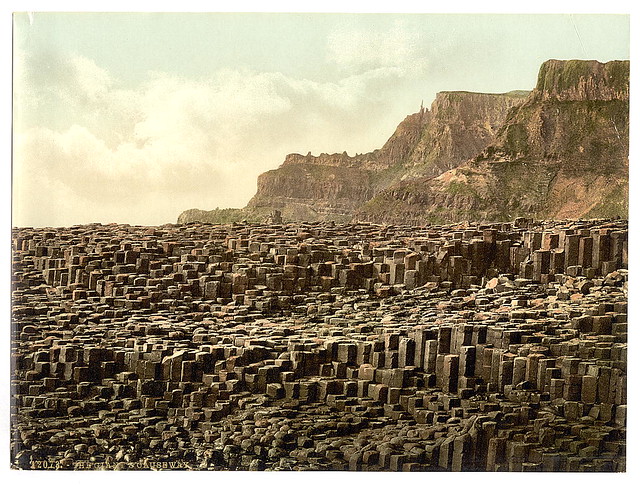
One of my most favorite places in the whole world (that I've never actually been to) is The Giant's Causeway in northern Ireland.

The summer after college I was a nanny for my cousins in a small town outside of Dublin called Dunboyne.  I was too young to get my Irish driver's license and ended up taking the kids to the city on the bus.  We did get to take weekend trips with the family to southern Ireland, but while I was there there was just too much unrest to visit up North.

Thus, this is the most amazing place in the world that I've always wanted to go to, but never have.  :)

The Giant's Causeway is a natural formation of rocks on the northern coast between Ireland and Scotland.  As you can see from the photos, these spires of rock form beautiful polygons, often hexagons, but reports are anything from quadrilaterals to nonagons. 

This, to me, is full of opportunities for great instruction.  I can see anything from estimation and basic polygon identification (3rd Grade) to tessellations and transformations. 

For this reason, I feel the EQUATE model is a perfect opportunity to explore these photos and this location.  Rather than focusing on a single grade, I encourage you to use the EQUATE thinking routine to apply appropriate standards at your grade level.

Grade Level: 3-HS

Course: Math, Pre-Alg, Algebra, Geometry

Standards:  3.MD.8, 3.G.1, 3.G.2, 4.MD.5, 4.G.1, 4.G.2, 4.G.3, 5.MD.5, 5.G.3, 5.G.4, 6.G.1, 6.G.2, 6.G.3, 6.G.4, 7.EE.3, 7.EE.4, 7.G.1, 7.G.6, 8.G.1, 8.G.2, 8.G.3, 8.G.4, G-CO.1, G-CO.2, G-CO.5, G-CO.6, G-CO.7, G-GPE.7, G-GMD.2, G-GMD.3, G-MD.1, G-MD.3
SMP: MP.1, MP.2, MP.3, MP.4, MP.5, MP.6, MP.7, MP.8
Skills: Estimation, Number sense, reasoning, modeling, geometry, geometric shapes, properties of shapes, area, perimeter, volume.


How to use this as a mad minute:
You have 60 seconds. Name all of the shapes you can see.

How to use this as a warm up:
You could ask the students to consider one of the following:
1.  Name the shapes you see.
2.  Does this fit the definition of a tessellation? Why or why not?
3.  Are these "regular" polygons?  Why or why not?

How to use this as a mini-lesson:
If I only had 20 minutes, I would use technology to explore this VERY COOL region.  This website has an awesome interactive map, some history, and the legend of the Giant's Causeway.

http://www.voicesfromthedawn.com/the-giants-causeway/

How to use this as a full lesson?
As I mentioned before, I feel that this is an ideal EQUATE lesson.  Although there is a ton of math that is obvious to an instructor, this captivates my interest because of the combination of legend, scientific history, and visual appeal.  I feel your students will also be drawn to these elements.  If you are comfortable, let the students dictate the direction of the lesson and exploration (within reason).

I would show these photos, let the students explore, discuss, etc.
Then I would list all of their questions, encouraging them to "wonder mathematically" about them.
Focused on grade-level appropriate standards, I would ask students to narrow down the questions to make sure they are relevant to things you have already explored or discussed in your class.
I would let the students ask YOU questions and you can provide the answers you feel are appropriate.  (How are they formed?  How big is the region?  How many are there?  You can provide as much or as little information as you wish.)
I would settle on a question (or two or three) for your students to apply their knowledge and continue to try to solve.  Encourage them to TRY something!  Draw on the photo, measure it, get online and do research, look up formulas that might be useful, gather information, start playing with the numbers, rules, formulas, photos, etc.
Finally, ask the students to Explain what they did, what they found, and how they approached the problem.

 How to use this as an assessment?
It is up to you if you think your students can use this as an assessment appropriately.

It could be something as simple as providing the first photo and asking students to outline as many different shapes as they can see and explain why they are different and what they are (Elementary School).

It could be more advanced, offering the size of the region, the size of an individual "step" and asking the students to estimate how many are in the entire region.  (Upper Elementary to Middle School.)

You could ask the students to find two similar "steps" and justify why they are similar (Middle/High).

You could ask the students to find the volume of two or three different "steps" and justify their solution methods.  (Middle/High).

You could ask the students to PROVE that two items are congruent or similar based on transformations such as rotations, reflections, etc.

Works Cited:
Photo 1
Description: Giant's Causeway and Causeway Coast
Copyright: © Philippe Croo
Author: Philippe Croo
Image Source: Philippe Croo  (Link)

Photo 2
http://farm3.staticflickr.com/2755/4427445338_7869405855_z.jpg?zz=1

Photo 3
https://garystravel.wordpress.com/page/107/


Please feel free to use any of these ideas and modify them to meet your needs.  However, please acknowledge the original source of the items and my own lesson outlines.  ©NatalieRSprigg 2013 

Sunday, June 2, 2013

Life's Complex Plane


Personal Reflection:
I love when someone, more creative than myself, is able to combine really awesome math with really deep thinking. I keep thinking that if we want to create critical thinkers, the people who create these kinds of images are the epitome of critical thinkers.  So...can we get kids to do the same?

Image Source

Grade Level: 6-9

Course: Pre-Algebra, Algebra

Standards:  6.NS.6.b, 6.NS.8, 7.RP.2.a 
SMP: MP2, MP3, MP4, MP7
Skills: Coordinate plane, critical thinking, graphing, analysis


How to use this as a mad minute:
You have 60 seconds. Explain your interpretation of this graph to a partner.

How to use this as a warm up:
You could ask the students to consider one of the following:
1.  If you had to give a title to each axis that would encompass the extremes, what would it be?
2.  Explain the relationships in each quadrant.
3.  Do sleepiness and joy have a direct or inverse relationship?
4.  Do you agree with the 4th quadrant?  Why or why not?
5.  Do you believe that dreams and reality are opposites?  Why or why not?  Use mathematics to back up your argument.

How to use this as a mini-lesson:
I'm going to assume (bad idea?) that you'll use this with kids who are familiar with the coordinate plane, the quadrants and how to read them.  This is not an introduction, but an elevation!  We've got 20 minutes?  Here we go!

0:00--Take 1 minute to read this, analyze it, and think about whether or not you agree with it.
1:00--Now, without talking, take the next minute to jot down your ideas, thoughts, etc.  You can draw, you can write, you can use notes, anything you want.
2:00--Now partner up and compare your thinking.  You have 60 seconds.
3:00--Ok, let's share out some ideas, thoughts and reflections.  What did you see?  Agree on?  Disagree on?
6:00--Ok, I'm interested in seeing if you can create your own "Complex Plane."  Let's start with 60 seconds of brainstorming opposites.
7:00--Let's list those where everyone can see them.
9:00--Ok, here's the challenge.  Take two pairs of opposites and put them on your axes.  (Dry erase boards, math journals, notebooks, etc.)  Now, try to imagine what each quadrant would represent.  (I'm going to include my own example, because it's not as easy as you might think!  First, the challenge is not to be swayed by the previous example.  I kept thinking of joy and sadness, or night and day, which both felt too close to the original.  I chose Hot & Cold and then Starving & Full.  I was thinking of temperatures of food, but without a title, that might not be clear.  Then I had to think, what food would be amazing hot and would make you full?  Not too hard for a high schooler to choose.  Pizza, Pasta, Cheeseburgers could all work.  Next, what would make you full when it is cold.  Ok.  Done.  But what food would you starve rather than eat?  Hot uncooked fish?  What food would you starve if you ate it cold?  That was the hardest.  Mine is not perfect, but it's my first effort.  I recommend you try this yourself several times before you ask the kids to do it!)

10:00, 11:00, 12:00--Check in on kids' progress.  Encourage them to keep going.  Ask them to create more than one if they struggled.
13:00--Let's partner up and share your results.  DO NOT EXPLAIN.  Ask your partner to study yours and then tell you what they think it shows.  Then flip.  You'll have 3 minutes total.
16:00-There is a fantastic website that creates graphical images like this almost every day.  thisisindexed.com.  Examine these two images.  Then try to create your own!

How to use this as a full lesson?
I probably wouldn't.  I think this is an engaging activity that sparks creativity, but is NOT destined for an entire class period.  However, if you wish, you can explore thisisindexed.com and select other images.  From there you can ask students to explain what is happening and to try to create their own.

Another option is for students to explore the site on their own (warning: a few images do pertain to more mature subject matter) and ask them to select their 4 favorites, analyze them and be prepared to explain them.  Browsing will take a lot of time!

 How to use this as an assessment?
I don't feel this is appropriate for a summative assessment.  Formative assessment will take place as you listen to student discussions and explanations.


Please feel free to use any of these ideas and modify them to meet your needs.  However, please acknowledge the original source of the items and my own lesson outlines.  ©NatalieRSprigg 2013

Saturday, May 25, 2013

Penny Floor

Personal Reflection:

Finding photos like this on popular "student" sites like 9gag.com always makes me happy!  I know, right away, that this will get them to "wonder mathematically" and dive into exploring skills and concepts that they might not have ever wanted to consider in the past.  My "wondering" and wandering led me to questions like:  How much would it cost to tile that area?  Is using pennies the cheapest?  How does that compare to normal tile?  I hope that your students will wonder mathematically in their own ways!

Grade Level: 4-9

Course: Math, Pre-Algebra

Standards:  5.NBT.5, 5.NBT.7, 5.MD.1, 6.PR.3d, 6.NS.1, 6.NS.3, 6.EE.1, 6.EE.2, 6.EE.7, 6.G.1
SMP: MP1, MP2, MP3, MP4, MP5, MP6
Skills: Area, Unit conversions, exponential notation, estimation


How to use this as a mad minute:
You have 60 seconds.  How much do you think it would cost to cover the floor of our classroom in pennies?  Estimate accurately and be prepared to justify your estimate.


How to use this as a warm up:
You could ask the students to consider one of the following:
1. How much do you think it would cost to tile our floor in pennies?  Estimate accurately, show your work and steps and be prepared to explain.
2.  Do you think covering the floor with pennies would cost MORE or less than covering it with nickles?  dimes? quarters? dollar bills?  Why?
3. Do you think covering the floor with pennies would cost more or less than using a traditional floor covering such as tile or carpet?  Why?
4. Is there a currency in the world that would be better to use than pennies?  If you can't think of one, can you think of what properties it would need to have to be a better choice?
 

How to use this as a mini-lesson:
If I had 20 minutes to spend on this lesson, and the goal was for kids to estimate, use critical thinking skills, use their knowledge of area, and compute, this is what I'd do!

Show them the photos!  Let them talk with their friends about them for less than 60 seconds.
Give them a challenge.  Tell them that you will offer (____reward_____) for the student who is able to BEST estimate the cost of covering ONE DESK (or table) in your room in pennies.
"Best" estimate, as determined by me, would not only be accurate, but would be clearly justified and explained.  It would specifically address concepts such as measurement, how to compute area, etc.  I would NOT equally reward a group that "counted" how many pennies fit along each side and multiplied and a group that used measurements, staggering (to fit more in), repeated trials and samples, etc.  Although both may be right, one shows much more depth of analysis and thinking.  The first would be perfect for an answer in 5 minutes or less, and the second would be appropriate for a 20 minute exploration.
I'd offer them a selection of supplies:
  1. Baggies of 10 or fewer pennies
  2. Rulers or meter sticks
  3. Tape
  4. Paper
It would be up to the students what supplies they might use.


How to use this as a full lesson?

Use the EQUATE thinking routine.  Give them the photos with NO guidance.  Let them Explore, Wonder, and Question.

Record their questions and clarify!  Develop depth to the questions by extending them, drawing out detail and asking how they might go further.

For example, a student might ask, "How much would that cost?"  This is a great "wonder" but not enough to explore mathematically.  What are they going to investigate?  How can they extend this question?  As you draw out these ideas, make sure to ask them to list what information they need to answer their questions.  Feel free to share answers or to encourage them to FIND THEIR OWN answers.  This is a great time to use technology to your advantage.  Students can research on phones and iPods, or you can nominate a class researcher who will research the answers to these questions while you continue to work with the rest of the class.  Narrow down your questions to your top two or three questions.  Tell them they can choose from "These" deep understanding questions to answer in their next steps.  It could be something from the suggested warm ups with more depth, it could be calculating the cost of covering the floor of your room, their bedrooms, the hallway, etc.  For students who are advanced, ask them to compare the prices of using pennies to nickels and dimes with only a ruler and one of each coin. 

Establish expectations for products, time frames, behaviors, and jobs.

Set them free!  Help them question and explore and apply their mathematical knowledge to solve their problems and answer their questions.  

How to use this as an assessment?
You know your students best, and you know if you will have prepared them for this.  I know many teachers ask challenge questions such as, "How many boxes of Kleenex will it take to fill this classroom?" as assessment questions.  However, many other background experiences are necessary before students can attack these kinds of problems independently on an assessment.

If you feel you've provided similar learning experiences that would help a student successfully approach such a problem, go for it!
  • Ask a specific and clear question.
  • Be sure you know what kinds of answers you will accept.
  • Determine how much written and verbal guidance you will provide during the assessment.
  • Make sure you provide clear rubrics or standards for achievement.  Students need to know what will earn a passing, or excelling, grade!
  • Make notes of what works and what doesn't so you can improve it for next time.

Every school grades differently, sometimes based on standards, some using IB or pre-IB rubrics, some on critical thinking and creativity, some on a strictly points-based system.  While I cannot help every one of you, in the future I will update this with my own question, instructions, and rubric!


Please feel free to use any of these ideas and modify them to meet your needs.  However, please acknowledge the original source of the items and my own lesson outlines.  ©NatalieRSprigg 2013

Wednesday, May 22, 2013

That's Some Inflation!

Personal Reflection:


I've heard recently about the collapse of Zimbabwe's currency and how they just keep printing larger and larger notes and that something like this probably wouldn't buy a cup of coffee.  (Apparently not true!) What causes inflation?  How does this connect to our own currency?  I know I wanted to investigate, so I hope students will too!

Grade Level: 4-9

Course: Math, Pre-Algebra, Algebra

Standards:  6.RP.1, 6.RP.2, 6.RP.3, 7.RP.1, 7.RP.2

SMP: MP1, MP2, MP3, MP4, MP5, MP6, MP7
Skills: Research, Conversion, Scientific Notation


How to use this as a mad minute:
You have 60 seconds.  What is this worth in US Dollars?


How to use this as a warm up:
You could ask the students to consider one of the following:
1.  Write one hundred trillion in scientific notation.
2.  As of May 21, 2013, 1 dollar in Zimbabwe is worth 0.00276 US Dollars.  How much is this note worth?
3.  What would 100 trillion US dollars be worth in Zimbabwe currency?
4.  If the US had 100 trillion dollars and divided it evenly among the citizens, how much would you get?
5.  Can you name the largest US bank note?  Why is that the largest one?
6.  Why can't poor countries just create these kinds of bills to pay off debts?


How to use this as a mini-lesson:
I would start with a conversation, asking students for their immediate thoughts and ideas.  PLEASE explore those and go with the flow!  They will ask amazing questions and take your class in directions you can't imagine!  If conversation stalls, try the warm up questions to get them talking and thinking.  They really need a way to frame this number!

Ask them to think about why the US doesn't create bills this large.  Is this even a real bill?  If so, could you cash it in at a bank?  Why or why not?

Why don't poor countries just make money like this and bring it to the US to cash it in? 

How to use this as a full lesson?
I would start with the warm up and mini lesson outlined above and then I would set the kids loose with a challenge.

CHOOSE ONE:
a.  Research inflation.  What causes it?  How is it controlled?  What happens when it isn't controlled?  How will inflation affect YOU in 20 years? 
OR
b.  Consider the IMP activity about the price of eggs.  (This is best for an Algebra 1 level class.)  It helps students to understand inflation and how prices grow and to predict the price of eggs in the future!  Link
OR
c.  Research the reasons for the collapse of the Euro and the financial crisis in Europe.  Create a 1 page poster that explains the BIG issues.  WHO?  WHAT? WHERE? WHEN?  WHY?
OR
d.  Choose a common item.  (Such as a pair of jeans.)  Find out the cost of that item in 5 different countries and convert it from the original currency to US Dollars.  (Use proportions to convert!)  Consider why prices vary so greatly in other countries.  Discuss why a pair of jeans would be more or less expensive elsewhere.

I'd ask students to be prepared to share their findings (perhaps in a jigsaw) with other students with about 15 minutes left in class.  This isn't intended to be a long term activity!

How to use this as an assessment?
You know your students best! I would not use this as a formal assessment.  You could, however, find a similar graphic and ask it as a constructed response item on an assessment of your own!  You could take any of the lesson options above and extend it with provided rubrics, more structured questions, etc.

Please feel free to use any of these ideas and modify them to meet your needs.  However, please acknowledge the original source of the items and my own lesson outlines.  ©NatalieRSprigg 2013

Tuesday, May 21, 2013

Algebraic Notation in Real Life

Personal Reflection:


I ran across these two images and thought it was a perfectly fun way to talk about algebraic properties!  My students LOVE the Lady Gaga reference, and the new tweet to the right captures both the mathematical spirit AND a terrible pun!

Grade Level: 7-9

Course: Pre-Algebra, Algebra

Standards:  6.EE.2, 6.EE.3, 6.EE.4, 6.EE.6, 7.EE.1, 7.EE.2, 7.EE.3, 7.EE.4, 8.EE.7B
SMP: MP1, MP2, MP3, MP4, MP7, MP8
Skills: Algebraic notation, Mathematical Properties, Multiplying polynomials, "FOIL" method


How to use this as a mad minute:
You have 60 seconds.  Are these accurate?  Why or why not? 


How to use this as a warm up:
You could ask the students to consider one of the following:
1. What mathematical property is illustrated here?
2. Make up your own (appropriate) 4 letter word.  Multiply it as if it were a polynomial.  What happens?
3.  Can you multiply 4 letters to create a REAL 8 letter word?
4.  Rewrite MISSISSIPPI as a distributive property problem.
5.  Rewrite SASSAFRAS as a distributive property problem.
6.  Can your name be shortened using Algebraic notation?  Why or why not?

How to use this as a mini-lesson:
I would start by verifying that these two problems DO, in fact, work.  I would ask the students to justify the mathematical properties that are used in each step to expand the problems.  I'd challenge them to take a common chorus and rewrite it.  For example:
Come they told me, pa rum pum pum pum
A new born King to see, pa rum pum pum pum
Our finest gifts we bring, pa rum pum pum pum
To lay before the King, pa rum pum pum pum,
rum pum pum pum, rum pum pum pum,

How to use this as a full lesson?
I would start with the warm up and mini lesson outlined above and then I would set the kids loose with a challenge.

EITHER:
a.  Rewrite your favorite song using accurate mathematical notation.  Be sure to justify each line by noting the property you are using to shorten the song!
OR
b.  Find 10 long and repetitive words (such as MISSISSIPPI) and rewrite them using mathematical notation.  Bonus points if you are able to create an entire sentence of such words!

How to use this as an assessment?
You know your students best! I would not use this as a formal assessment.  You could, however, find a similar graphic and ask it as a constructed response item on an assessment of your own!


Please feel free to use any of these ideas and modify them to meet your needs.  However, please acknowledge the original source of the items and my own lesson outlines.  ©NatalieRSprigg 2013

Swimming Pools of Saliva

Personal Reflection:

Let's start off with being honest.  I do my share of internet surfing.  Two sites I visit regularly for their awesome "kid" content are uberhumor.com and 9gag.com.  You'll see their watermarks at the bottom of most of my photos.

This one stood out to me right away because I thought, "NO WAY!"   (And I bet your students will think that too!)  So, I thought, "Let's find out."
  

Grade Level: 3-8

Course: Math, Pre-Algebra

Standards:  6.EE.2, 6.EE.3, 6.EE.9, 6.G.2, 7.RP.1, 7.RP.2, 7.G.1, 7.G.6

SMP: MP1, MP2, MP3, MP4, MP5, MP7
Skills: Estimation, Volume, Unit conversion, Scientific Notation


How to use this as a mad minute:
Get out those smart phones, those electronic devices, iPods, laptops, iPads, etc.  Is this true?  Can you find an answer in 60 seconds or less?  GO!


How to use this as a warm up:
You could ask the students to consider one of the following:
1. List the information would you need to gather to determine this is true.
2.  Estimate how much saliva you produce in 1 hour.  1 day.  1 week.  1 year.
3.  How big is a swimming pool?  How much water do you think it holds?
4.  Calculate the volume of a swimming pool that is 50m x 25m x 2m.  (Olympic average.)
5.  How much saliva do you think is in a single cubic meter of water?
6.  If the volume of an Olympic Pool is 2,500,000 L, how much saliva does one person produce each day?

How to use this as a mini-lesson?
You have to decide how much freedom to give your students and how structured you want this to be.  It could be a great inspiration for how to find the volume of a rectangular prism (true swimming pools that are more like trapezoidal prisms), or how to convert between metric and English measurements, or how to convert between large and small numbers, or even how to use scientific notation appropriately.


Mini Lesson 1:  Volume
Let's find the volume of different pools!  (Olympic, neighborhood, backyard pools)
Olympic:  50m x 25m x 2m  (Note: Olympic pools are not rectangular prisms, but this is an average.)
Neighborhood:  25m x 10m x 1.5m  (Kids could find out their own measurements!)
Backyard:  Radius=2m, Depth= 1.5m (Cylinder volume!)

Mini Lesson 2:  Unit Conversion
Saliva is measured in ounces.  How much is 2,500,000 Liters  in ounces?  How do you convert?  What proportions do you use?

Mini Lesson 3:  Scientific Notation
An Olympic Swimming pool has a volume of about 2,500,000 Liters.  Write this in scientific notation.  If the average person creates 1 liter of saliva every day for 79 years, how much saliva will they create in a lifetime?  Write your answer in scientific notation.  Which number is larger?

Mini Lesson 4:  Is this reasonable?
If you are trying to do this as a mini lesson, kids will need as MUCH information as possible.  You will need to tell them how much an average pool holds.  (Olympic=2.5 million liters)  You'll need to tell them how much saliva a person produces each day.  (Approximately 1 liter)  How long does the average person live?  (In the US it is approximately 79 years)  Can you use this information to determine if the average person would fill a swimming pool with saliva?


How to use this as a full lesson?
Expand any of the mini lessons above to include practice problems, a homework worksheet, or a continued exploration.  For example:  How long would it take to fill a bathtub with saliva?  How much saliva does the city of Denver create each day?  Each year?  Is the amount of saliva created each year by the population of China MORE or less than the amount of water in The Great Lakes?

How to use this as an assessment?
You know your students best!  If I were doing this with a GOOD group of middle school students who had mastered volume, this is the assessment I'd give them.

Look at this meme!  Is it true?  Use your technology to research both saliva production and the size of swimming pools.  Then use your knowledge of volume to answer whether or not this is reasonable.   Justify your answers with clear mathematical knowledge and computation.  Use the rubric to get full credit!

My rubric would require showing formulas for volume and how it was computed, how they got their numbers for the dimensions of the pool and the amount of saliva and the life span, including documenting sources.  I'd want them to explain answers in complete sentences with correct mathematical vocabulary.

If your kids aren't ready for this freedom, structure it for them!  (But, please, give them a chance and build the opportunities.  They'll get there, I promise!)


Please feel free to use any of these ideas and modify them to meet your needs.  However, please acknowledge the original source of the items and my own lesson outlines.  ©NatalieRSprigg 2013