Showing posts with label 5th Grade Standards. Show all posts

Friday, April 25, 2014

Odometer

Personal Reflection:
Like many math teachers, I have a slight obsession with really cool number patterns.  "Palindrome" numbers are some of my favorites (along with series, repetition, etc.)  I took the opportunity to take a photo (stopped, you'll notice) of my odometer when it reached 77,477 miles.  (On a side note, my new job has me doing a LOT of commuting, and I'm over 90k now, which shows how much I'm driving and how much I procrastinated on this post!)

Grade Level: 4-5

Course: 4th or 5th Grade Mathematics

Standards: 4.OA.5,  4.NBT.4, 5.OA.3, 5.NBT.5
SMP: MP2, MP5, MP6, MP8
Skills: Patterns, numeric relationships, addition, subtraction


How to use this as a mad minute:
You have 60 seconds. 
List as many palindromic numbers as you can.

How to use this as a warm up:
Tell the students what this shows, review what an odometer measures, and what a palindrome is.
1.  Why is this a palindrome?
2.  What would be the next 10 times I'd have a palindrome on my odometer?
3.  Do you see any patterns in the palindromes?

How to use this as a mini-lesson:
I would repeat the warm up above, but exclude the third question.  I would ask the students to work in groups to try to figure out how many times my odometer had "hit" a palindrome from the time I bought it (7 miles!) to the time that is shown above.  I would use the third question as a way to help kids who ares struggling trying to list ALL of the possible answers.  If they can identify patterns, they will shorten their process.

Push students to make observations about the patterns, to look for ways to generalize, and identify the final answer.  (In my own calculations, I THINK the answer is 674 times.  I am not positive, and will recheck my work.  My thinking is posted in a photo here.)


How to use this as a full lesson?
Expanding on the mini-lesson above, the focus REALLY has to be on number properties and patterns.  Students are NOT going to quickly answer the question of "How many times."  In fact, if they are not developing effective strategies and using patterns, they could easily get stuck in the listing routine for an entire period.

With a focus on selecting students who have a variety of strategies, definitely ask students to prepare to share their thinking (either on a poster, a dry erase board, on to put under a document camera).  Select a variety of approaches and sequence them in a way that will help students who are stuck make more efficient progress.

Other extensions you might offer could include:

  • If this person drives 3,000 miles a month, how often can she expect to see a palindrome?
  • How long until her next palindrome?
  • What other "special" numbers might this person look forward to?  (I like repeated numbers "33333" and "sequences" of numbers "12345")
  • How many of these such numbers would she encounter between 0 and 1,000 miles?
  • How many prime number has she hit between 0 and 77,477 miles?

Car Talk, one of my favorite radio shows, had a number puzzle dealing with palindromes and odometers.  Click here.  (A very advanced explanation and solution can be found here.)

Another great challenge that deals with palindromes, as well as merging speed, is included at this site.

How to use this as an assessment?

This is not directly tied to assessed standards.  I do not feel it is appropriate as an assessment item, only as a critical thinking, perseverance, and practice problem.


Please feel free to use any of these ideas and modify them to meet your needs.  However, please acknowledge the original source of the items and my own lesson outlines.  ©NatalieRSprigg 2014  

Wednesday, June 5, 2013

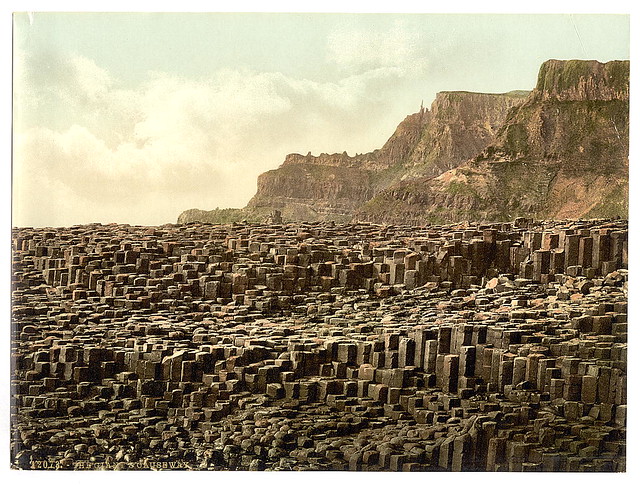
Giant's Causeway

Personal Reflection:

One of my most favorite places in the whole world (that I've never actually been to) is The Giant's Causeway in northern Ireland.

The summer after college I was a nanny for my cousins in a small town outside of Dublin called Dunboyne.  I was too young to get my Irish driver's license and ended up taking the kids to the city on the bus.  We did get to take weekend trips with the family to southern Ireland, but while I was there there was just too much unrest to visit up North.

Thus, this is the most amazing place in the world that I've always wanted to go to, but never have.  :)

The Giant's Causeway is a natural formation of rocks on the northern coast between Ireland and Scotland.  As you can see from the photos, these spires of rock form beautiful polygons, often hexagons, but reports are anything from quadrilaterals to nonagons. 

This, to me, is full of opportunities for great instruction.  I can see anything from estimation and basic polygon identification (3rd Grade) to tessellations and transformations. 

For this reason, I feel the EQUATE model is a perfect opportunity to explore these photos and this location.  Rather than focusing on a single grade, I encourage you to use the EQUATE thinking routine to apply appropriate standards at your grade level.

Grade Level: 3-HS

Course: Math, Pre-Alg, Algebra, Geometry

Standards:  3.MD.8, 3.G.1, 3.G.2, 4.MD.5, 4.G.1, 4.G.2, 4.G.3, 5.MD.5, 5.G.3, 5.G.4, 6.G.1, 6.G.2, 6.G.3, 6.G.4, 7.EE.3, 7.EE.4, 7.G.1, 7.G.6, 8.G.1, 8.G.2, 8.G.3, 8.G.4, G-CO.1, G-CO.2, G-CO.5, G-CO.6, G-CO.7, G-GPE.7, G-GMD.2, G-GMD.3, G-MD.1, G-MD.3
SMP: MP.1, MP.2, MP.3, MP.4, MP.5, MP.6, MP.7, MP.8
Skills: Estimation, Number sense, reasoning, modeling, geometry, geometric shapes, properties of shapes, area, perimeter, volume.


How to use this as a mad minute:
You have 60 seconds. Name all of the shapes you can see.

How to use this as a warm up:
You could ask the students to consider one of the following:
1.  Name the shapes you see.
2.  Does this fit the definition of a tessellation? Why or why not?
3.  Are these "regular" polygons?  Why or why not?

How to use this as a mini-lesson:
If I only had 20 minutes, I would use technology to explore this VERY COOL region.  This website has an awesome interactive map, some history, and the legend of the Giant's Causeway.

http://www.voicesfromthedawn.com/the-giants-causeway/

How to use this as a full lesson?
As I mentioned before, I feel that this is an ideal EQUATE lesson.  Although there is a ton of math that is obvious to an instructor, this captivates my interest because of the combination of legend, scientific history, and visual appeal.  I feel your students will also be drawn to these elements.  If you are comfortable, let the students dictate the direction of the lesson and exploration (within reason).

I would show these photos, let the students explore, discuss, etc.
Then I would list all of their questions, encouraging them to "wonder mathematically" about them.
Focused on grade-level appropriate standards, I would ask students to narrow down the questions to make sure they are relevant to things you have already explored or discussed in your class.
I would let the students ask YOU questions and you can provide the answers you feel are appropriate.  (How are they formed?  How big is the region?  How many are there?  You can provide as much or as little information as you wish.)
I would settle on a question (or two or three) for your students to apply their knowledge and continue to try to solve.  Encourage them to TRY something!  Draw on the photo, measure it, get online and do research, look up formulas that might be useful, gather information, start playing with the numbers, rules, formulas, photos, etc.
Finally, ask the students to Explain what they did, what they found, and how they approached the problem.

 How to use this as an assessment?
It is up to you if you think your students can use this as an assessment appropriately.

It could be something as simple as providing the first photo and asking students to outline as many different shapes as they can see and explain why they are different and what they are (Elementary School).

It could be more advanced, offering the size of the region, the size of an individual "step" and asking the students to estimate how many are in the entire region.  (Upper Elementary to Middle School.)

You could ask the students to find two similar "steps" and justify why they are similar (Middle/High).

You could ask the students to find the volume of two or three different "steps" and justify their solution methods.  (Middle/High).

You could ask the students to PROVE that two items are congruent or similar based on transformations such as rotations, reflections, etc.

Works Cited:
Photo 1
Description: Giant's Causeway and Causeway Coast
Copyright: © Philippe Croo
Author: Philippe Croo
Image Source: Philippe Croo  (Link)

Photo 2
http://farm3.staticflickr.com/2755/4427445338_7869405855_z.jpg?zz=1

Photo 3
https://garystravel.wordpress.com/page/107/


Please feel free to use any of these ideas and modify them to meet your needs.  However, please acknowledge the original source of the items and my own lesson outlines.  ©NatalieRSprigg 2013 

Tuesday, June 4, 2013

"Friends" Gym Membership


Personal Reflection:

Not all of my inspiration comes from lame humor sites.  :)  Just the other day I was watching a rerun of "Friends" (probably while working on a blog post) and saw this intro.  I can't embed the video (but a link is included here), but did include screen shots.  Basically, Chandler has a Gym Membership that he doesn't use and can't get out of.

Here's the thing:  I think that in order to create TRUE mathematicians, kids need to "wonder mathematically" much more often.  Sure, they might laugh at the joke, but do they ever "wonder" what those numbers actually mean?  Do they have any number intuition?  Can we GET kids to wonder mathematically?  My EQUATE thinking model asks kids to do just that.  Unfortunately, I'm not sure that this is cut out to be an EQUATE type of problem.

Grade Level: 4 & 5 (Though, a fun, quick warm up at nearly any grade!)

Course: 4th &5th Grade Math

Standards:  4.NBT.1, 4.NBT.5, 4.NBT.6, 5.NBT.6
SMP: MP1, MP3, MP4  
Skills: Multiplication and Division, Unit Conversion


How to use this as a mad minute:
You have 60 seconds.  Estimate how long it has been since Chandler went to the gym.  Estimate how much money he has wasted. 

How to use this as a warm up:
You could ask the students to consider one of the following:
1.  How long has it been since Chandler went to the gym?  Write your answer in weeks and months.  Should your answer be written in years?  Why or why not?
2.  How much money has Chandler wasted by not going to the gym?
3.  List 3 things that Chandler could have purchased with that money.
4.  Explain how you could have estimated the answers to problems 1 & 2 using mental math.

How to use this as a mini-lesson:
Let's be honest.  This isn't going to be a major lesson at any grade level.  It's going to be a silly, fun, and quick activity to focus kids on thinking mathematically and to be aware of the math around them every day.

Usually I offer 20 minute mini-lessons.  I feel that if you want to use it as a mini-lesson, expand on the questions outlined in the warm up.  Give them time to reflect with partners, work with groups, explain their thinking and show their work.  REALLY focus on number sense, estimation, and mental math.  Consider giving a small prize (pencil?  Sticker?) to the student who estimates the length of time and expense most accurately. 

How to use this as a full lesson?
See above.

However, here are several other math "fails" in TV and movies that might spark discussion in classes for basic math.

I don't know the name of this movie/show, but it is Ma and Pa Kettle.

Abbott and Costello (Selling vacuum cleaners)
Abott and Costello (Donuts)  Note: The math logic is the same as the vacuums!

Abbott and Costello (Two Tens for a Five)
Abbott and Costello (It's Payday!)

How to use this as an assessment?
I wouldn't!  If you want to, choose one of the videos above and ask the students to explain the flaws in their thinking!


Please feel free to use any of these ideas and modify them to meet your needs.  However, please acknowledge the original source of the items and my own lesson outlines.  ©NatalieRSprigg 2013

Saturday, May 25, 2013

Penny Floor

Personal Reflection:

Finding photos like this on popular "student" sites like 9gag.com always makes me happy!  I know, right away, that this will get them to "wonder mathematically" and dive into exploring skills and concepts that they might not have ever wanted to consider in the past.  My "wondering" and wandering led me to questions like:  How much would it cost to tile that area?  Is using pennies the cheapest?  How does that compare to normal tile?  I hope that your students will wonder mathematically in their own ways!

Grade Level: 4-9

Course: Math, Pre-Algebra

Standards:  5.NBT.5, 5.NBT.7, 5.MD.1, 6.PR.3d, 6.NS.1, 6.NS.3, 6.EE.1, 6.EE.2, 6.EE.7, 6.G.1
SMP: MP1, MP2, MP3, MP4, MP5, MP6
Skills: Area, Unit conversions, exponential notation, estimation


How to use this as a mad minute:
You have 60 seconds.  How much do you think it would cost to cover the floor of our classroom in pennies?  Estimate accurately and be prepared to justify your estimate.


How to use this as a warm up:
You could ask the students to consider one of the following:
1. How much do you think it would cost to tile our floor in pennies?  Estimate accurately, show your work and steps and be prepared to explain.
2.  Do you think covering the floor with pennies would cost MORE or less than covering it with nickles?  dimes? quarters? dollar bills?  Why?
3. Do you think covering the floor with pennies would cost more or less than using a traditional floor covering such as tile or carpet?  Why?
4. Is there a currency in the world that would be better to use than pennies?  If you can't think of one, can you think of what properties it would need to have to be a better choice?
 

How to use this as a mini-lesson:
If I had 20 minutes to spend on this lesson, and the goal was for kids to estimate, use critical thinking skills, use their knowledge of area, and compute, this is what I'd do!

Show them the photos!  Let them talk with their friends about them for less than 60 seconds.
Give them a challenge.  Tell them that you will offer (____reward_____) for the student who is able to BEST estimate the cost of covering ONE DESK (or table) in your room in pennies.
"Best" estimate, as determined by me, would not only be accurate, but would be clearly justified and explained.  It would specifically address concepts such as measurement, how to compute area, etc.  I would NOT equally reward a group that "counted" how many pennies fit along each side and multiplied and a group that used measurements, staggering (to fit more in), repeated trials and samples, etc.  Although both may be right, one shows much more depth of analysis and thinking.  The first would be perfect for an answer in 5 minutes or less, and the second would be appropriate for a 20 minute exploration.
I'd offer them a selection of supplies:
  1. Baggies of 10 or fewer pennies
  2. Rulers or meter sticks
  3. Tape
  4. Paper
It would be up to the students what supplies they might use.


How to use this as a full lesson?

Use the EQUATE thinking routine.  Give them the photos with NO guidance.  Let them Explore, Wonder, and Question.

Record their questions and clarify!  Develop depth to the questions by extending them, drawing out detail and asking how they might go further.

For example, a student might ask, "How much would that cost?"  This is a great "wonder" but not enough to explore mathematically.  What are they going to investigate?  How can they extend this question?  As you draw out these ideas, make sure to ask them to list what information they need to answer their questions.  Feel free to share answers or to encourage them to FIND THEIR OWN answers.  This is a great time to use technology to your advantage.  Students can research on phones and iPods, or you can nominate a class researcher who will research the answers to these questions while you continue to work with the rest of the class.  Narrow down your questions to your top two or three questions.  Tell them they can choose from "These" deep understanding questions to answer in their next steps.  It could be something from the suggested warm ups with more depth, it could be calculating the cost of covering the floor of your room, their bedrooms, the hallway, etc.  For students who are advanced, ask them to compare the prices of using pennies to nickels and dimes with only a ruler and one of each coin. 

Establish expectations for products, time frames, behaviors, and jobs.

Set them free!  Help them question and explore and apply their mathematical knowledge to solve their problems and answer their questions.  

How to use this as an assessment?
You know your students best, and you know if you will have prepared them for this.  I know many teachers ask challenge questions such as, "How many boxes of Kleenex will it take to fill this classroom?" as assessment questions.  However, many other background experiences are necessary before students can attack these kinds of problems independently on an assessment.

If you feel you've provided similar learning experiences that would help a student successfully approach such a problem, go for it!
  • Ask a specific and clear question.
  • Be sure you know what kinds of answers you will accept.
  • Determine how much written and verbal guidance you will provide during the assessment.
  • Make sure you provide clear rubrics or standards for achievement.  Students need to know what will earn a passing, or excelling, grade!
  • Make notes of what works and what doesn't so you can improve it for next time.

Every school grades differently, sometimes based on standards, some using IB or pre-IB rubrics, some on critical thinking and creativity, some on a strictly points-based system.  While I cannot help every one of you, in the future I will update this with my own question, instructions, and rubric!


Please feel free to use any of these ideas and modify them to meet your needs.  However, please acknowledge the original source of the items and my own lesson outlines.  ©NatalieRSprigg 2013

Thursday, May 23, 2013

But it's a dry heat...

Personal Reflection:

I love "math fails" but I think these are really just "editing" fails!  We all make typos, some are just MUCH BIGGER than others!  I found two temperature fails in a short period of time and decided to go with them!  I encourage my kids to "wonder mathematically" a lot, and my own mathematical wondering led to this exploration.

Grade Level: 4-9

Course: Math, Pre-Algebra, Algebra

Standards:  5.NF.3, 5.NF.4, 5.NF.6, 6.EE.2, 6.EE.3, 6.EE.9
SMP: MP2, MP3, MP4, MP5, MP7
Skills: Research, Conversion, Science, Temperature scales


How to use this as a mad minute:
You have 60 seconds.  Name 3 different temperature scales.  Would these temperatures be appropriate in any of those scales?


How to use this as a warm up:
You could ask the students to consider one of the following:
1.  Do you think the temperatures listed are in Farenheit or Celsius?  Why? 
2. Given the chart at the right, convert one of the "high" temperatures from Kelvin to Celsius and Farenheit.  (Assume the temperature is in Kelvin.)
3. Why do you think there are multiple systems of temperature measurement? 
4. Can you think of a place that might actually be 519 degrees?  Where?  Why?
5. The weatherman is pointing at a temperature of 519 degrees, but immediately below, it says the high temperature is 52 degrees.  Based on this, can you guess what error might have occurred?  Explain.  Do you think the 789 degree temperature was the same mistake?  Why or why not?

How to use this as a mini-lesson:
I would start with a conversation, asking students what they know about temperature, different temperature scales, etc.  You might want to ask what body temperature, room temperature, and freezing and boiling points are on different scales.   They really need a way to frame this number!
Feel free to use the Dan Meyer technique of saying, "Choose a number you are SURE is TOO BIG" for room temperature in Celsius," or a number that is TOO SMALL for body temperature in Farenheit.  This helps the students work on both estimation, number sense, and confidence in math.

Introduce the Kelvin scale and why it is used.  Offer major numbers such as freezing and boiling, room temperature or body temperature on the scale.  Talk about why we have a scale like this.

If kids have access to technology, set them free to answer these questions themselves and be prepared to come back and share their findings!  You could challenge them:  "Is there a place in the US that could reach these temperatures?"  "Is there a place on Earth that could reach these temperatures?"  "Is there a place in our Solar System?"  Ask them to use their knowledge to make informed decisions, not random searches.

Gentle guidance could help:
  • What planets might be more likely to be warmer?  Why?  
  • What kinds of environments are warmer? 

Depending on the level of your students, ask them to explore the temperatures of different planets.  What traits do they possess when they are hotter?  How do scientists record temperatures on other planets?  If it's a mini-lesson, it's probably not a major lesson or life goal, but a chance to spark interest, address a cool concept and move on.  Don't let the details stop you from letting the kids explore!


How to use this as a full lesson?

Use the EQUATE thinking routine.  Give them the photos with NO guidance.  Let them Explore, Wonder, and Question.

Record their questions and clarify!  Develop depth to the questions by extending them, drawing out detail and asking how they might go further.

For example, a student might ask, "Is that even possible?"  This is a great "wonder" but not enough to explore mathematically.  What are they going to investigate?  How can they extend this question?  As you draw out these ideas, make sure to ask them to list what information they need to answer their questions.  Feel free to share answers or to encourage them to FIND THEIR OWN answers.  This is a great time to use technology to your advantage.  Students can research on phones and iPods, or you can nominate a class researcher who will research the answers to these questions while you continue to work with the rest of the class.  Narrow down your questions to your top two or three questions.  Tell them they can choose from "These" deep understanding questions.

Establish expectations for products, time frames, behaviors, and jobs.

Set them free!  Help them question and explore and apply their mathematical knowledge to solve their problems and answer their questions. 

How to use this as an assessment?
You know your students best! I would not use this as a formal assessment.  You could, however, find a similar graphic and ask it as a constructed response item on an assessment of your own!  You could take any of the lesson options above and extend it with provided rubrics, more structured questions, etc.

Please feel free to use any of these ideas and modify them to meet your needs.  However, please acknowledge the original source of the items and my own lesson outlines.  ©NatalieRSprigg 2013