Showing posts with label Thinking Routine. Show all posts

Thursday, June 27, 2013

Workout

Personal Reflection:
I'm going to be honest right up front.  I'm not a runner.  So when I workout on a treadmill, it's a pretty slow jog.  The beauty of this post is that if you choose to use it with your students, they can laugh and criticize the person on the treadmill and you can promise left and right it isn't you, and you can agree, the person here is one step above a sloth!  :)

That being said, I can't be the only "numbers nerd" out there that is constantly doing mental math while working out.  Maybe you count your reps when lifting weights and calculate the total pounds you've lifted?  Maybe you set a swimming goal and are finding the fractional portion of your workout completed with each length or lap?  Maybe you figure out how many hours you'll have to stay on the treadmill to burn that milkshake you enjoyed last night?  I know I'm constantly looking at the numbers and doing a variety of calculations.  I couldn't help but take a few photos today thinking that the wealth of information included on the screen is invaluable.

Grade Level: 7-9

Course: Pre-Algebra, Algebra

Standards:  8.EE.5, 8.EE.6, 8.F.2, 8.F.3, 8.F.4, 8.F.5, 8.SP.1, 8.SP.2, 8.SP.3, N-Q.1, A-CED.2, A-CED.3, A-REI.10, F-IF.4, F-IF.5, F-IF.6, F-BF.1, F-LE.1, 
SMP: SMP.1, SMP.2, SMP.3, SMP.4, SMP.5, SMP.6, SMP.7, SMP.8

Skills: Algebra, Functions, Lines of best fit, slope, rate of change, real life application, computation, extrapolating data


How to use this as a mad minute:
You have 60 seconds. List all of the questions you could answer given the four photos provided.

How to use this as a warm up:
You could ask the students to consider one of the following:
1.  Write down three reactions you have looking at these photos.
2.  What information is provided in these photos?
3.  Is this person moving at a constant rate?  (Consider vertical movement as well as speed.)
4.  Is this person burning calories at a constant rate?
5.  Can you write an equation given the information above?  (Try it!) 

How to use this as a mini-lesson:
To use this as a mini-lesson, expand on the warm up questions above.  You can ask students to make data tables, graph the data provided, and to compare rates of change and determine if a line of best fit is appropriate.  Students can show the data in multiple ways and can then evaluate the graph, equations and tables to identify real-life meanings (What does the slope mean in the graph?  What does the intercept represent?)  A copy of all four photos on a single page is available here.

Note:  I didn't provide my 20 minute script because I feel this is best used as an EQUATE lesson, below.

How to use this as a full lesson?
I feel this situation is IDEAL for the EQUATE lesson routine.  As you may already know, this relies heavily on letting students explore what is most meaningful to them and then asking questions to guide their exploration and results.  I can only outline what "might" happen, but students have ways of amazing us!

EXPLORE--Provide a photo copy of all four photos on a single page.  Give them a few minutes to look at the photos and discuss them with their teammates.  You may structure this conversation and provide guidelines as your classroom expectations dictate.

QUESTION--Ask the students to brainstorm the types of questions they could explore given these photos.  What do they "wonder" about mathematically?  Is there enough information to answer those questions?  Remember to push your students to think mathematically and to ask questions appropriate for their grade level.  Asking if it is linear is a great start, but asking if they can use information to tell MORE than that is key.  Challenge them to ask and answer challenging questions.  Questions I might expect or encourage:
  • Is the rate of linear (and/or) vertical movement constant? What about the rate of calories burned?
  • How fast is this person moving?  
  • Based on the information I can see, were they always moving at this rate?  
  • How long will it take to "climb" a mile?
  • How long will it take to "run" a marathon?  What about burning off my favorite meal?
 Note:  Some questions are much more basic than others.  The last few questions require analysis offered in the first two or three questions, but students could easily get "stuck" with having too much information or too many steps to explore.

Additionally, this is where students get to ask you for more information.  If you can provide it, great!  If not, push them to answer their question given the information provided or to do the research needed to answer the question.  For example, I would NOT tell them whether or not the person was moving at a constant rate.  I would, however, allow them to look up the number of feet in a mile or the length of a marathon.  (I wouldn't tell them, but I'd help them access appropriate resources!)

APPLY--Remember to encourage your students to apply their learning!  If students know how to write equations from a table of data, they should do so!  If students know how to make accurate graphs, they should do so!  This is a great time to reflect on the units you have worked on and what skills students have obtained.  This will encourage students to apply those skills to their problem solving process.

TRY SOMETHING--Encourage the kids to get working!  They may feel "stuck" or that they dont' know what to do.  Try anyway!  That's the goal.  Get going, try something and see what happens.  Of course, kids need guidance, but it is their job to take their exploration, their questions, their previous knowledge and apply it to work on finding solutions.

EXPLAIN--Students need to wrap up their exploration by explaining not only what they did, but why they did it, how their previous knowledge related to the problem, and what inferences they drew.  They need to be able to justify their answers and how they know that their solution is both reasonable and accurate.

How to use this as an assessment?
If your students have experience with looking a real life data to explore questions like the ones above, let them go!  Give them a challenge question and the data and make sure they don't just find a numeric answer but also that they explain their process and thinking!

Please feel free to use any of these ideas and modify them to meet your needs.  However, please acknowledge the original source of the items and my own lesson outlines.  ©NatalieRSprigg 2013 

Sunday, June 23, 2013

Summer on Uranus

Personal Reflection:
This is another photo from uberhumor.com.  I find that this site, though not always student-appropriate, does have a mix of "items" that often lend themselves to discussion and exploration.

This is a pretty simple fact.  It is easy to research the accuracy of this fact and determine that if the orbit of Uranus around the sun is 84 years, then "summer" or 1/4 of that time, would be 21 years.  But to me, there's so much more to ask and so much more to explore.

This is also an ideal way to encourage students to use background knowledge to build a "case" for the accuracy of this fact and then confirm their answers electronically.

Note:  As a special addition below, I included some ideas for interdisciplinary connections!

Grade Level: Middle School 
Course: Pre-Algebra 
Standards:  Science:  5-8 Standard D, 9-12 Standard B  (Though math is involved, I don't think this relates to specific standards.) 
SMP: SMP.1, SMP.2, SMP.3, SMP.6, SMP.8

Skills: Critical thinking, research, questioning, Algebra, Computation


How to use this as a mad minute:
You have 60 seconds. Outline your immediate reaction to this and back it up with either scientific or mathematical knowledge.

How to use this as a warm up:
You could ask the students to consider one of the following:
1.  If "summer" on Uranus lasts 21 years, what do you know about it's period of rotation about the sun?
2.  Based on what you know about Uranus, what do you think "summer" looks and feels like?
3.  The Earth is tilted on its axis by 23º.  Uranus is tilted by 82º.  What does that tell you about seasons on the planet?
4.  The length of a day on Uranus is -0.718 Earth days.  What does the number tell you?  What does the negative mean?

How to use this as a mini-lesson:
Given 20 minutes, I would focus on discovery, exploration, and discussion.  For this mini lesson students will need access to the internet.
0:00--Let's look at this image!  (Show the graphic.)  Take a minute to think about it and discuss your immediate reaction with a friend.
1:00--What did you see or say to your partners?
2:00--Let's brainstorm.  What do you already know about seasons, Earth and Uranus?  Talk with a partner, write down everything you can think of, you have two minutes!
4:00--Partner up with another group and share your lists.  Add anything you don't have on your own.  Put a ? mark next to anything you are unsure about or disagree with.
5:00--Repeat combining two more groups.
6:00--Let's share out what you know!
8:00--Let's share items you were unsure of or to which you put a ? mark.  (Remember, you don't want them to ask, "Is this true?" just yet.  This is a valid question, but we are trying to build and confirm background knowledge.  Students WILL check out the validity of this number, but not quite yet.  Explain to them that they can answer this question shortly, but we are focusing more on things like, "Seasons are caused by the tilt of a planet on its axis." or "Uranus is tilted much more on its axis."  These are items that will help students answer the question on their own, eventually.)
9:00--You are going to have 3 minutes.  I want you to research anything you listed EXCEPT the length of summer on Uranus!  Make sure you find valid sites and make sure you document your sources!
12:00--Everyone had different questions.  Did everyone find their answers?  Were there any questions you were unable to answer?  Can anyone help them or tell them the answer?
14:00--Let's see if you can use your knowledge to answer the following questions.  I'm going to ask 2 questions and then give you and your team 3 minutes to answer them.   You should NOT use the Internet to answer.  1.  If summer is 21 years on Uranus, how long is a year?  2.  Does the length of summer (or a year) relate to how big Uranus is or how far away it is from the Sun? 
17:00--Confirm your answers using any resources you prefer!
19:00--So this simple graphic is TRUE!  Awesome!  What other questions would you like to explore now that you've seen this?

How to use this as a full lesson?
I really feel this is ideal for an EQUATE Lesson.  (Click link for explanation.)

I can see the students wanting to know if this is true, but that is far too simple and can be answered easily by Google.  It will require some fantastic questioning strategies from the teacher to guide students to more challenging or deep questions.  Off the top of my head, I would want to explore the following questions:
  • Which planet has the longest and shortest "summers"?
  • Which planet has the longest and shortest days?
  • Does the size of the planet relate to the length of the "summer" or "day"?
  • Do other planets have seasons like summer?  Why or why not?
  • What does "summer" look like on other planets?  (For example, Earth is tilted on its axis as it rotates, creating seasons, but other planets are not tilted or are tilted nearly 90 degrees, this causes great variation.  Also, gas planets don't heave "seasons" in the same way as others, and in some planets, though the temperatures vary, there's not what we would consider a season!)
Please note:  Some of my questions seem basic, but, as any good teacher knows, the depth is in the WHY? So don't forget to ask!

I found this site to be useful.  (NASA--Planetary Seasons)

How to use this as an assessment?
I don't feel this is appropriate for an assessment.  (You may feel otherwise and of course, feel free to use it!)

Interdisciplinary Connections
Ray Bradbury's short story "All Summer In A Day" is a great connection.  However, it can be a bit disturbing and you should definitely preview it before using it with students.

There is also a short (30 min) movie version of "All Summer In A Day"

I would definitely work with your team to, perhaps, have students read the story, watch the movie, research seasons on planets and, it's up to you, then assess their understanding.  My first thought is to separate students and hold a debate about how accurate the story/movie are, and whether or not this is a fair representation.  Students would need to back up their arguments with scientific evidence about the seasons on various planets as well as other items of "accuracy" such as life on another planet.


Please feel free to use any of these ideas and modify them to meet your needs.  However, please acknowledge the original source of the items and my own lesson outlines.  ©NatalieRSprigg 2013 

Wednesday, June 5, 2013

Giant's Causeway

Personal Reflection:

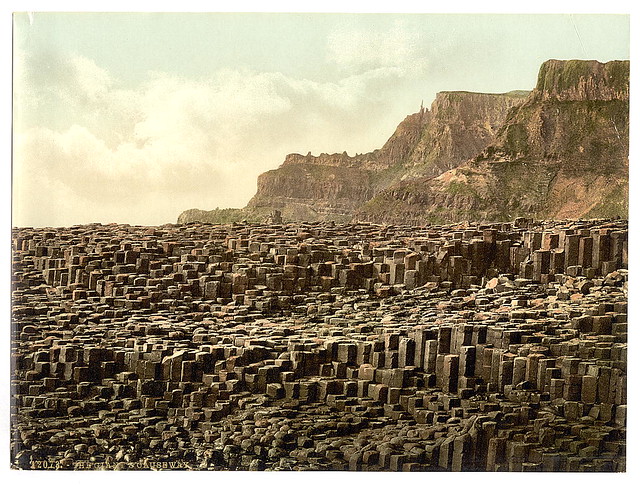
One of my most favorite places in the whole world (that I've never actually been to) is The Giant's Causeway in northern Ireland.

The summer after college I was a nanny for my cousins in a small town outside of Dublin called Dunboyne.  I was too young to get my Irish driver's license and ended up taking the kids to the city on the bus.  We did get to take weekend trips with the family to southern Ireland, but while I was there there was just too much unrest to visit up North.

Thus, this is the most amazing place in the world that I've always wanted to go to, but never have.  :)

The Giant's Causeway is a natural formation of rocks on the northern coast between Ireland and Scotland.  As you can see from the photos, these spires of rock form beautiful polygons, often hexagons, but reports are anything from quadrilaterals to nonagons. 

This, to me, is full of opportunities for great instruction.  I can see anything from estimation and basic polygon identification (3rd Grade) to tessellations and transformations. 

For this reason, I feel the EQUATE model is a perfect opportunity to explore these photos and this location.  Rather than focusing on a single grade, I encourage you to use the EQUATE thinking routine to apply appropriate standards at your grade level.

Grade Level: 3-HS

Course: Math, Pre-Alg, Algebra, Geometry

Standards:  3.MD.8, 3.G.1, 3.G.2, 4.MD.5, 4.G.1, 4.G.2, 4.G.3, 5.MD.5, 5.G.3, 5.G.4, 6.G.1, 6.G.2, 6.G.3, 6.G.4, 7.EE.3, 7.EE.4, 7.G.1, 7.G.6, 8.G.1, 8.G.2, 8.G.3, 8.G.4, G-CO.1, G-CO.2, G-CO.5, G-CO.6, G-CO.7, G-GPE.7, G-GMD.2, G-GMD.3, G-MD.1, G-MD.3
SMP: MP.1, MP.2, MP.3, MP.4, MP.5, MP.6, MP.7, MP.8
Skills: Estimation, Number sense, reasoning, modeling, geometry, geometric shapes, properties of shapes, area, perimeter, volume.


How to use this as a mad minute:
You have 60 seconds. Name all of the shapes you can see.

How to use this as a warm up:
You could ask the students to consider one of the following:
1.  Name the shapes you see.
2.  Does this fit the definition of a tessellation? Why or why not?
3.  Are these "regular" polygons?  Why or why not?

How to use this as a mini-lesson:
If I only had 20 minutes, I would use technology to explore this VERY COOL region.  This website has an awesome interactive map, some history, and the legend of the Giant's Causeway.

http://www.voicesfromthedawn.com/the-giants-causeway/

How to use this as a full lesson?
As I mentioned before, I feel that this is an ideal EQUATE lesson.  Although there is a ton of math that is obvious to an instructor, this captivates my interest because of the combination of legend, scientific history, and visual appeal.  I feel your students will also be drawn to these elements.  If you are comfortable, let the students dictate the direction of the lesson and exploration (within reason).

I would show these photos, let the students explore, discuss, etc.
Then I would list all of their questions, encouraging them to "wonder mathematically" about them.
Focused on grade-level appropriate standards, I would ask students to narrow down the questions to make sure they are relevant to things you have already explored or discussed in your class.
I would let the students ask YOU questions and you can provide the answers you feel are appropriate.  (How are they formed?  How big is the region?  How many are there?  You can provide as much or as little information as you wish.)
I would settle on a question (or two or three) for your students to apply their knowledge and continue to try to solve.  Encourage them to TRY something!  Draw on the photo, measure it, get online and do research, look up formulas that might be useful, gather information, start playing with the numbers, rules, formulas, photos, etc.
Finally, ask the students to Explain what they did, what they found, and how they approached the problem.

 How to use this as an assessment?
It is up to you if you think your students can use this as an assessment appropriately.

It could be something as simple as providing the first photo and asking students to outline as many different shapes as they can see and explain why they are different and what they are (Elementary School).

It could be more advanced, offering the size of the region, the size of an individual "step" and asking the students to estimate how many are in the entire region.  (Upper Elementary to Middle School.)

You could ask the students to find two similar "steps" and justify why they are similar (Middle/High).

You could ask the students to find the volume of two or three different "steps" and justify their solution methods.  (Middle/High).

You could ask the students to PROVE that two items are congruent or similar based on transformations such as rotations, reflections, etc.

Works Cited:
Photo 1
Description: Giant's Causeway and Causeway Coast
Copyright: © Philippe Croo
Author: Philippe Croo
Image Source: Philippe Croo  (Link)

Photo 2
http://farm3.staticflickr.com/2755/4427445338_7869405855_z.jpg?zz=1

Photo 3
https://garystravel.wordpress.com/page/107/


Please feel free to use any of these ideas and modify them to meet your needs.  However, please acknowledge the original source of the items and my own lesson outlines.  ©NatalieRSprigg 2013 

Saturday, May 25, 2013

Penny Floor

Personal Reflection:

Finding photos like this on popular "student" sites like 9gag.com always makes me happy!  I know, right away, that this will get them to "wonder mathematically" and dive into exploring skills and concepts that they might not have ever wanted to consider in the past.  My "wondering" and wandering led me to questions like:  How much would it cost to tile that area?  Is using pennies the cheapest?  How does that compare to normal tile?  I hope that your students will wonder mathematically in their own ways!

Grade Level: 4-9

Course: Math, Pre-Algebra

Standards:  5.NBT.5, 5.NBT.7, 5.MD.1, 6.PR.3d, 6.NS.1, 6.NS.3, 6.EE.1, 6.EE.2, 6.EE.7, 6.G.1
SMP: MP1, MP2, MP3, MP4, MP5, MP6
Skills: Area, Unit conversions, exponential notation, estimation


How to use this as a mad minute:
You have 60 seconds.  How much do you think it would cost to cover the floor of our classroom in pennies?  Estimate accurately and be prepared to justify your estimate.


How to use this as a warm up:
You could ask the students to consider one of the following:
1. How much do you think it would cost to tile our floor in pennies?  Estimate accurately, show your work and steps and be prepared to explain.
2.  Do you think covering the floor with pennies would cost MORE or less than covering it with nickles?  dimes? quarters? dollar bills?  Why?
3. Do you think covering the floor with pennies would cost more or less than using a traditional floor covering such as tile or carpet?  Why?
4. Is there a currency in the world that would be better to use than pennies?  If you can't think of one, can you think of what properties it would need to have to be a better choice?
 

How to use this as a mini-lesson:
If I had 20 minutes to spend on this lesson, and the goal was for kids to estimate, use critical thinking skills, use their knowledge of area, and compute, this is what I'd do!

Show them the photos!  Let them talk with their friends about them for less than 60 seconds.
Give them a challenge.  Tell them that you will offer (____reward_____) for the student who is able to BEST estimate the cost of covering ONE DESK (or table) in your room in pennies.
"Best" estimate, as determined by me, would not only be accurate, but would be clearly justified and explained.  It would specifically address concepts such as measurement, how to compute area, etc.  I would NOT equally reward a group that "counted" how many pennies fit along each side and multiplied and a group that used measurements, staggering (to fit more in), repeated trials and samples, etc.  Although both may be right, one shows much more depth of analysis and thinking.  The first would be perfect for an answer in 5 minutes or less, and the second would be appropriate for a 20 minute exploration.
I'd offer them a selection of supplies:
  1. Baggies of 10 or fewer pennies
  2. Rulers or meter sticks
  3. Tape
  4. Paper
It would be up to the students what supplies they might use.


How to use this as a full lesson?

Use the EQUATE thinking routine.  Give them the photos with NO guidance.  Let them Explore, Wonder, and Question.

Record their questions and clarify!  Develop depth to the questions by extending them, drawing out detail and asking how they might go further.

For example, a student might ask, "How much would that cost?"  This is a great "wonder" but not enough to explore mathematically.  What are they going to investigate?  How can they extend this question?  As you draw out these ideas, make sure to ask them to list what information they need to answer their questions.  Feel free to share answers or to encourage them to FIND THEIR OWN answers.  This is a great time to use technology to your advantage.  Students can research on phones and iPods, or you can nominate a class researcher who will research the answers to these questions while you continue to work with the rest of the class.  Narrow down your questions to your top two or three questions.  Tell them they can choose from "These" deep understanding questions to answer in their next steps.  It could be something from the suggested warm ups with more depth, it could be calculating the cost of covering the floor of your room, their bedrooms, the hallway, etc.  For students who are advanced, ask them to compare the prices of using pennies to nickels and dimes with only a ruler and one of each coin. 

Establish expectations for products, time frames, behaviors, and jobs.

Set them free!  Help them question and explore and apply their mathematical knowledge to solve their problems and answer their questions.  

How to use this as an assessment?
You know your students best, and you know if you will have prepared them for this.  I know many teachers ask challenge questions such as, "How many boxes of Kleenex will it take to fill this classroom?" as assessment questions.  However, many other background experiences are necessary before students can attack these kinds of problems independently on an assessment.

If you feel you've provided similar learning experiences that would help a student successfully approach such a problem, go for it!
  • Ask a specific and clear question.
  • Be sure you know what kinds of answers you will accept.
  • Determine how much written and verbal guidance you will provide during the assessment.
  • Make sure you provide clear rubrics or standards for achievement.  Students need to know what will earn a passing, or excelling, grade!
  • Make notes of what works and what doesn't so you can improve it for next time.

Every school grades differently, sometimes based on standards, some using IB or pre-IB rubrics, some on critical thinking and creativity, some on a strictly points-based system.  While I cannot help every one of you, in the future I will update this with my own question, instructions, and rubric!


Please feel free to use any of these ideas and modify them to meet your needs.  However, please acknowledge the original source of the items and my own lesson outlines.  ©NatalieRSprigg 2013

Thursday, May 23, 2013

EQUATE! Thinking Routines

The EQUATE thinking routine is a process I've used in my math classroom based on a constructivist approach.  This routine allows for students to explore a real life situation, wonder mathematically, ask questions, apply their mathematical knowledge, dive into the problem and solution opportunities and finally explain their results. 

This has worked as an assessment tool, a tool to develop interest in concepts, a tool for introduction to skills and formulas, and a great way to establish classroom routines and expectations.  You'll see me refer to EQUATE in other areas of my blog, and this is what I'm speaking of.  Please feel free to ask questions if any area is unclear!

(The above image is property of Andrew Sabatier, and is not my own.)

E—Explore—In this step the students discuss the situation and problem and come up with any questions they have for you. You may return to this piece over and over.

Qu—Question—In this step students ask you all of the questions that they have. You may
or may not have the answers.

(Now is a good time to have them go back and explore and see if they have more questions based on what they found out.)

A—Apply—This is when they will apply their knowledge and the information they gained from their questions to try to solve the problem. This may include investigations, trials, research, deriving formulas, doing calculations, etc.

T—Try Something—This is the “DO” piece. Even if they don’t know what they are doing, they need to take action. At any time they can come back to explore and question.

E—Explain—After they have arrived at an answer, they should explain it. How did they get there? Is it reasonable? How can they be sure they are right? What strategies did they use?


Please feel free to use any of these ideas and modify them to meet your needs.  However, please acknowledge the original source of the items and my own lesson outlines.  ©NatalieRSprigg 2013